
So there is an electronics retailer that has locations in Geneva and elsewhere, and I really like it. In fact, I love it.
It’s one of those places I’ve gone to for years, and my experience there had been overwhelmingly positive for decades. Or at least it was until recently.
Last year, I went in to buy a new laptop. A straightforward, if somewhat expensive, purchase.
It was late in the day, the store was approaching closing time, and I already knew I wanted a MacBook Pro. I figured it wouldn’t take long to complete the transaction. That is, until the gentleman I was dealing with decided to try to upsell me on seemingly everything under the sun.
He kept suggesting more and more services. It started with an antivirus solution, which he practically framed as necessary, because according to him, Apple had basically stripped macOS of the security features it once included.
That struck me as odd. I felt like I would have heard about that.
The pricing was presented as a multi-year plan, but only after asking directly did it become clear that the price mentioned initially covered the first year only.
Then came an extended warranty.
At that point, the interaction had already changed. I found myself suddenly completely distrusting the salesperson I initially found quite pleasant.
Of course, on the surface, everything was still polite and very professional.
But at that point, I became very focused on the interaction rather than the product I was there to buy.
I had initially agreed to the four-year subscription plan for the antivirus when I thought the fee he indicated covered that full period, but as more add-ons were introduced, I declined them. Then reconsidered the initial one as well and opted out entirely. I told the salesperson I’d only be buying the computer. Nothing else.
What shocked me even more was that, as I became more resistant, the offers became more flexible. Discounts were suddenly being offered: “Well, we’ll just charge you for the first year… it’s the end of the day… and you seem like a nice person.”
At that point, I simply no longer had a clear understanding of what I was even being sold, so I purchased the computer (and only the computer) and ended the conversation altogether.
Customer experience (CX) research often comes back to a simple idea: what matters is the gap between expectation and reality.
In a retail context, that expectation isn’t just about the product. It’s about clarity, transparency and the sense that information is being shared to help you decide. Not to pressure you one way or the other.
Add time pressure to the mix (end of day, closing time), and the cognitive load increases dramatically. Because it’s no longer just about making the right decision, but also about concluding the interaction in a timely manner.
And when every new piece of information being presented to you requires clarification, and feelings of doubt start to seep in because claims feel difficult to verify right then and there, it just creates unnecessary tension and friction.
When similar experiences start to surface across locations or over time, it often reflects incentives tied to add-ons, pressure to upsell, and advice that blurs the line between suggestions and outright pressure.
At that point, the dynamic shifts. The person advising you is no longer fully aligned with your interests, even if they appear to be. What you’re seeing isn’t just a sales tactic, but a structural misalignment between what’s good for the customer and what’s being rewarded internally. This is known as the principal–agent problem.
From a business perspective, these strategies might make sense at first glance. But from a customer experience perspective, they are questionable at best.
Because depending on what’s being sold, the success of these techniques often relies on the customer not fully understanding the offer. So you see the ethical conundrum here.
There’s a well-documented effect in behavioral psychology, known as the peak-end rule, which suggests that we don’t remember experiences in full. What we mostly do remember is their most intense moment, and how they end.
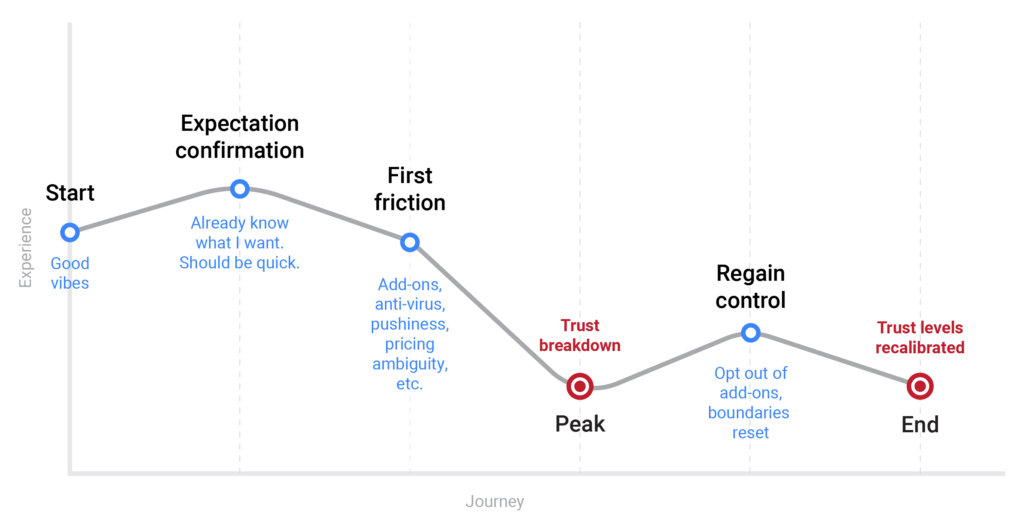
And in this case, both pointed in the same direction. And that direction is known as dark patterns in UX: deceptive techniques to manipulate users into making decisions they didn’t initially intend to make. I don’t see how this is any different when it comes to CX.
At the end of the day, I still like the store. I like wandering around looking at their products. They certainly have a great selection.
Except now, the moment a salesperson begins suggesting additional services, I end the interaction quickly. I’ll just say “I already have coverage for that” whether or not it’s true. They usually keep trying and I keep shutting their attempts down.
One time, not long after the MBP incident, I purchased a smartwatch that happened to be on sale. Not even one of those really expensive ones, and they immediately came at me with the extra warranty spiel. When I said no (because of course I did), the salesperson said, “well it’s too bad, it’s a pretty expensive watch, do you really want to take any chances on it?”
And I thought to myself, “Dude, for real? Are you really going to give me the old ‘would be an awful shame if something happened to it’ routine?”
Look, trust, once questioned, doesn’t magically reset. I still shop there, but I know other customers have made a very different choice.
So… just sayin’… lose your customers’ trust at your peril, because there aren’t always going to be second chances.
This post was co-written with ChatGPT to refine ideas, structure arguments, and enhance clarity.